Tight Writing Gets Published
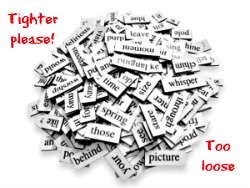
Editors and publishers demand tight writing. Anything less will be rejected. So aim to pack your ideas into compact sentences that make every word count.
Loose writing contains:
- Extra and unnecessary articles (a, the, and an)
- Repeated words
- Passive verb constructions (the book was laid on the table)
- Too many weak verbs (was, is, are and were)
- Wordy phrases (for example: I am going to be able to may be changed to I can)
In a tight piece of work nothing can be removed without altering intent.
Tight Writing is Equally Important in Business
Tight writing is as important for businesses as for creative writers, except that customers, not editors, will reject poor writing. Consider these paragraphs, excerpted from the popular FlexJobs.com website:
This time of year tends to be a time when a shift in focus is made from work to home. Even many businesses slow down at the end of the year as they begin to focus and transition into the strategies of the new year. The same goes for freelance professionals—there are a few things freelancers should do before the end of the year.
During the holiday slowdown, freelancers should consider their needs in an effort to end the year strong and also begin focusing on their New Year’s freelance job search strategy. As many businesses scale back on hiring during this time, it is the perfect opportunity to get ahead of the game.
Here are six things freelancers should do before the end of the year
Now Consider my Revision:
At this time of year our focus naturally shifts from work to home. Many businesses slow down and scale back on hiring as they transition into strategies for the upcoming year. This lull gives freelance professionals the perfect opportunity to reassess their own year-end needs.
Freelancers will end the year well if they use the holiday slowdown to define their New Year’s goals and freelance job search strategy.
Six Tasks Freelancers Should Tackle Before Year-End
I hope you find the revision clearer and easier to read after my edit. I reorganized slightly, removed redundancies and made it compact and precise.
Dont worry about accomplishing these goals in your first draft. You will make your writing tighter with each revision and consistent practice. So write your first draft, and then REVISE, REVISE, REVISE!
I've created four simple steps to make trimming the fat easier. If you'd like me to do it for you, please contact me to learn more.
Four Simple steps to tight writing
1. Eliminate Extra Words
Tight writing aims for brevity, so combine sentences to remove repetition and to make your writing dense and compact. Look especially for the word "the" and remove as many as possible. In finding a way to remove them, you will necessarily tighten the rest.
- Loose: All the pieces of Greta's furniture were emptied out of the truck and carried into the inside of the apartment. Inside, Greta found a place for each of the pieces. [Note five unnecessary articles, one weak verb, and several redundancies--into an apartment, for example, suggests "inside," so "inside" is redundant.]
- Tighter: Movers emptied the truck and carried Greta's furniture into her apartment, where she arranged each piece.
In this example I eliminated 12 of 30 words by focusing on the two most important pieces of information--movers emptied their truck and Greta arranged her furniture. Maybe you can eliminate more words. Make a game of this. Resolve to cut each paragraph in half as you revise. Many new writers don't believe that a 50% reduction is possible, but you may be surprised.
For fun (yes I'm weird that way!), I reworked my first attempt to see if I could cut an additional three words, or a full 50% of the original. This last version imparts the message with the most precision and accuracy.
- Tightest: Movers transferred Greta's furniture from their truck into her apartment, where she arranged each piece.
2. Choose Active Verbs
Note how, in the revision above, the movers "emptied" the truck. This change eliminates the passive verb construction were emptied. Restructuring sentences to name those taking action reduces wordiness and makes writing more interesting.
There are is another weak verb construction.
- Loose: There are many lights dotting the city landscape.
- Tighter: Many lights dot the city landscape.
3. Resist Adverbs
Adverbs rarely add value to a sentence. They describe weak verbs. Choose stronger verbs, and ditch the adverb.
- Loose: Her fingers moved clumsily over the coins.
- Tighter: She fumbled with the coins.
4. Be Specific
Tight writing avoids vague words such as thing or things. Specific words make the sentence more interesting.
- Loose: He put some things into his backpack and walked out the door.
- Tighter: He tossed his lucky rock and a change of clothes into his backpack and strode out the door.
When you reveal which items your character chooses, you also show his character. A character who packs a gun and a pair of leather gloves is more menacing than one who chooses his favourite notebook and several drawing pencils.
- Loose: Something happened that left her feeling uneasy.
- Tighter: She froze as the floor creaked and the doorknob turned.
Search your writing for thing, something, and somehow. These are the usual culprits in vague writing.
More Creative Writing Help
Passive Verbs: Avoid Them and Breathe New Life Into Your Fiction
Search this site: